Pale Blue Dot: There is no god
I am exuding big atheist energy for this one, so you might want to close this page if you're not into that.
A few months ago, I finished reading Pale Blue Dot by Carl Sagan. Very few other works have resonated so much with me,1 so I wanted to take some extra time to reflect.
One of my main takeaways was: there is no god.2
Did you know that in the 1600s, the church was OK with the heliocentric model of our solar system if it was only used for calculations?
It was a kind of split-brain compromise, the Sun-centered system was treated as a mere computational convenience, not an astronomical reality—that is, the Earth was really at the center of the Universe, as everybody knew; but if you wished to predict where Jupiter would be on the second Tuesday of November the year after next, you were permitted to pretend the Sun was at the center. Then you could calculate away and not affront the Authorities.3
All part of the mental gymnastics to prove that humans are at the center of it all, when really we are not. We're not at the center of our solar system. Our galaxy is not at the center of the universe.
Our universe is 15 billion years old, and the Earth itself has existed for 4.5 billion years.
As for humans, we're latecomers. We appear in the last instant of cosmic time. The history of the Universe till now was 99.998 percent over before our species arrived on the scene.4
As for the size of the universe, according to Wikipedia:
The observable universe contains as many as an estimated 2 trillion galaxies and, overall, as many as an estimated 1024 stars – more stars (and, potentially, Earth-like planets) than all the grains of beach sand on planet Earth.
Look at that sheer amount of time and space. These are numbers so large that they're nearly meaningless to our human minds. We're not even a blink of an eye. Barely a grain of sand in the vast cosmic beach.
Human gods seem so insignificant and implausible in this vastness. It's like caring about a microbe — I personally don't give a shit about bacteria #5,259,763,139,774 on my left elbow, and I suspect there isn't a god that cares about Bob Smith, human #4,525,823,932, on Earth, planet #395,803,583,334,398,857,148,211.
I didn't expect Carl Sagan to hammer this point repeatedly, but he does. It's one of the core themes of this book.
For example, this is the eponymous "pale blue dot" image:
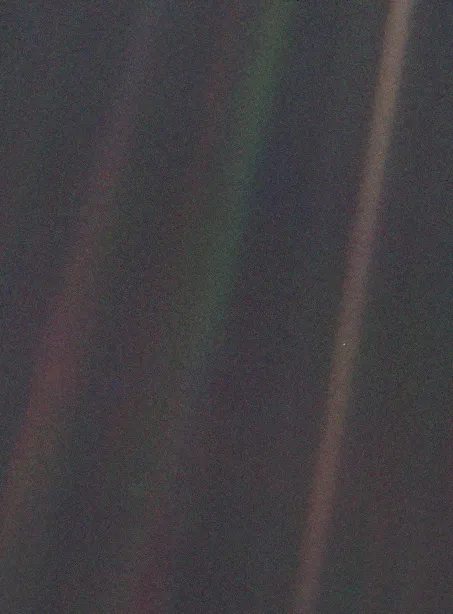
And perhaps the book's most famous quote:
Look again at that dot. That's here. That's home. That's us. On it everyone you love, everyone you know, everyone you ever heard of, every human being who ever was, lived out their lives. The aggregate of our joy and suffering, thousands of confident religions, ideologies, and economic doctrines, every hunter and forager, every hero and coward, every creator and destroyer of civilization, every king and peasant, every young couple in love, every mother and father, hopeful child, inventor and explorer, every teacher of morals, every corrupt politician, every "superstar," every "supreme leader," every saint and sinner in the history of our species lived there—on a mote of dust suspended in a sunbeam.5
I was already an atheist before reading this book, but if I had any remaining inkling that god existed, this book completely killed that. Why would any god that cares about us create a universe as massive as this one, and then plonk humans on a tiny speck of dust?
Take a good long look at [that pale blue dot]. Stare at the dot for any length of time and then try to convince yourself that God created the whole Universe for one of the 10 million or so species of life that inhabit that speck of dust. Now take it a step further: Imagine that everything was made just for a single shade of that species, or gender, or ethnic or religious subdivision. If that doesn't strike you as unlikely, pick another dot. Imagine it to be inhabited by a different form of intelligent life. They, too, cherish the notion of a God who has created everything for their benefit. How seriously do you take their claim?6
For most of history, humanity didn't know anything. And when we don't know, we speculate. We fill the void with our guesses. For our ancestors, who tended to anthropomorphize as we do, that guess happened to be god. Our media is filled with animals that talk and act like humans.7 Our religious texts are similar, with entities that have distinctly human traits. God was clearly made in our image.
This is unthinkable for many people. For much of human history, god was as natural as the sun and sky. As reflexive as breathing or blinking. And without god, without our significance, what do we do? How do we cope?
... these deprovincializations rankle. Even if they do not fully carry the day, they erode confidence—unlike the happy anthropocentric certitudes, rippling with social utility, of an earlier age. We long to be here for a purpose, even though, despite much self-deception, none is evident. ... Our time is burdened under the cumulative weight of successive debunkings of our conceits: We're Johnny-come-latelies. We live in the cosmic boondocks. We emerged from microbes and muck. Apes are our cousins. Our thoughts and feelings are not fully under our own control. There may be much smarter and very different beings elsewhere. And on top of all this, we're making a mess of our planet and becoming a danger to ourselves.8
And I get that. If you grew up with god and human-centrism as the default, those ideas are the very foundation of your mental models. Questioning that means questioning everything you've built on those models: your reflexive thoughts, conscious actions, the people you associate with, your entire life. This kind of uncertainty is very disturbing, and it requires a lot of time and energy to navigate.
My take on it, once you get past the "oh shit my whole life is a lie":
Life on earth was somewhat of an accident, not designed by god. And this is fucking awesome. The universe sneezed one day and the first self-replicating molecules emerged.9 Over time, life persisted and natural selection added flair, eventually creating beings as complex as cats and humans. Human society developed enough complexity to manufacture cat toys at scale and post cat pics on the internet. It's incredible that we're alive and conscious, here and now.
I find this incredibly freeing. There's no grand plan for us to fuck up.
But, it's also a call to action.
Our posturings, our imagined self-importance, the delusion that we have some privileged position in the Universe, are challenged by this point of pale light. Our planet is a lonely speck in the great enveloping cosmic dark. In our obscurity, in all this vastness, there is no hint that help will come from elsewhere to save us from ourselves.10
We have full responsibility. There's no god to magically solve your issues. There's also no god to stand in your way. No supernatural being will answer your prayers, but they also won't be around to damn you for all eternity. We're only accountable to ourselves and the world around us. Our actions matter.
In this way, humans are a bit special. We're the first earth species to intentionally leave the earth, and the first that "by its own voluntary actions, has become a danger to itself—as well as to a vast number of others."11 We're capable of greatness, as individuals and as a collective. We have spacecraft zooming around the solar system. Modern medicine routinely performs miracles. Show me an ape that's created anything like skibidi toilet.
With great power comes great ability to fuck shit up (to quote Spiderman). Our carbon emissions are killing the earth. Israel is genociding Palestinians. Donald Trump has nukes. An untold amount of human and animal suffering occurs every second, even while we're in one of the most peaceful and prosperous human eras.
But the cosmos doesn't hear any of this. It's silent in space. These are "the squabbles of mites on a plum",12 in the vast expanse of the universe.
It's only us, with all our greatness and our flaws, somehow existing here, on this mote of dust.
We'll figure it out together, one way or another. And that's good enough for me.
I imagine religious people find tremendous meaning and comfort in reading their holy texts, and I felt the the same way when I read Pale Blue Dot.↩
God, gods, godesses; I'm using "god" as a general term for any supernatural, all-powerful beings that are invested in human affairs.↩
Page 19 of whatever edition I have, about halfway through Chapter 2: Aberrations of Light.↩
Page 30, in the first half of Chapter 3: The Great Demotions.↩
Page 8. It's towards the end of Chapter 1: You are Here.↩
Page 11, the very first paragraph of Chapter 2: Aberrations of Light.↩
We give our AI chatbots human names and refer to them with human pronouns. Whenever someone says, "I asked Claude and he said ...," it hurts my soul. It's a goddamn LLM, it doesn't have a gender! But that's part of our natural instinct to see things as human, even when we logically know they are not.↩
Pages 52-53, towards the end of Chapter 4: A Universe Not Made for Us.↩
This is my uneducated guess for the origin of life on earth.↩
Page 9, towards the end of Chapter 1: You are Here.↩
Page 370, halfway through Chapter 21: To the Sky!↩
Page 219, near the beginning of Chapter 14: Exploring Other Worlds and Protecting this One.↩